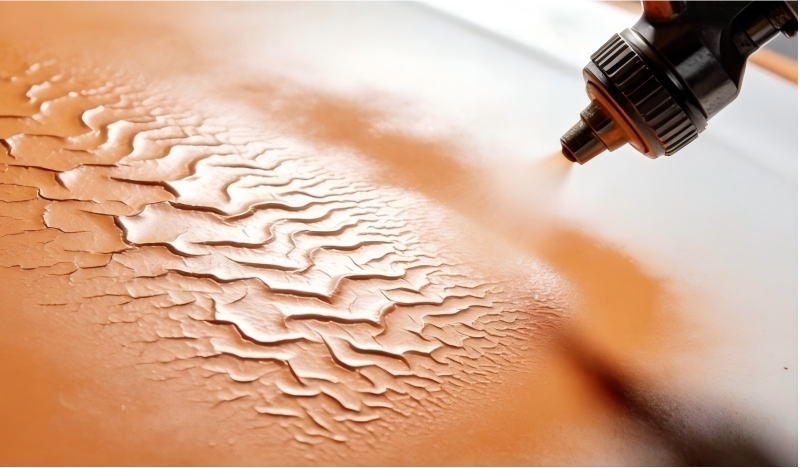
In the coating industry, the “orange peel effect” is a common surface defect that significantly impacts the appearance quality of painted products. This phenomenon refers to an uneven, textured surface resembling the peel of an orange, which not only affects aesthetics but may also compromise the protective performance of the coating. This article provides an in-depth analysis of the causes of orange peel effect and offers practical solutions based on the application of coating equipment.
1. Excessively Fast Solvent Evaporation
When solvents evaporate too quickly, the coating film loses its fluidity before it has enough time to level out, resulting in an uneven surface texture.
2. Poor Leveling Properties of the Coating
Some coatings lack sufficient leveling agents or use inappropriate formulations, preventing the film from flowing evenly after application.
3. Mismatch Between Spray Gun Nozzle and Coating Viscosity
Using a nozzle that is too large for low-viscosity coatings, or too small for high-viscosity coatings, leads to poor atomization and uneven film formation
4. Improper Spraying Parameters
Incorrect settings such as spraying distance, air pressure, and fluid output can negatively affect atomization quality and coating uniformity.
5. Poor Substrate Surface Condition
Uneven or rough surfaces, as well as contaminants on the substrate, hinder the leveling process and intensify the orange peel effect.
6. Moisture Contamination in Coating or Thinner
Moisture absorbed during storage or application can destabilize the coating system and degrade film quality.
1. Select the Appropriate Thinner
Choose thinners with moderate evaporation rates based on ambient temperature, humidity, and coating type to allow sufficient leveling time.
2. Optimize Coating Viscosity
Adjust the coating to the recommended viscosity as per the manufacturer’s specifications to ensure proper atomization and leveling.
3. Choose the Right Spray Gun Nozzle Size
Select a nozzle size suitable for the coating type. For topcoats, a 1.3–1.5 mm nozzle is generally recommended.
4. Adjust Spraying Parameters
Maintain a spraying distance of 15–25cm and air pressure between 0.3–0.5 MPa to achieve optimal atomization and uniform film application.
5. Ensure Substrate Surface Smoothness
Properly sand and clean the substrate before spraying to remove dust, oil, and irregularities that may affect leveling.
6. Strengthen Coating Management
Store coatings and thinners in sealed containers to prevent moisture absorption. Filter materials before use if contamination is suspected.
Modern coating equipment plays a critical role in preventing orange peel defects. Advanced systems such as precision pressure regulators, automated spray booths, and robotic painting systems help stabilize environmental conditions and process parameters, significantly reducing variability caused by manual operations. By adopting automated coating solutions, manufacturers can achieve consistent film quality while improving production efficiency.
The orange peel effect is a common quality issue in coating processes, but it can be effectively prevented through careful selection of coatings, proper equipment configuration, and precise process control. As a professional coating equipment supplier, we are committed to providing high-quality spraying solutions and technical support to help our customers achieve superior surface finishing results.
Copyright © 2025 Yangzhou OURS Machinery Co., Ltd.All rights reserved. - Privacy policy
 EN
EN
